Showing posts with label हिंसा. Show all posts

Thursday, July 25, 2019

Indian female farmers going 'womb-less' to boost productivity by Devyani Nighoskar 24 Jul 2019

Despite national awareness campaigns, menstruation is still a taboo subject in India and impoverished people are most at risk [File: Reuters]
Maharashtra state, India - Pushpa, a farmer and mother of two, was 26 when she experienced heavy bleeding during her period and abdominal pain.
She took medicine for two years until a doctor advised a more serious "cure".
She soon became one of the many women in the villages of Beed district, which is in the Indian state of Maharashtra, to undergo a surgical procedure to remove her womb.
"It was not an easy decision to make. But my husband encouraged me to do it, because the pain affected my work. The hysterectomy caused some hormonal imbalance and I put on weight," said Pushpa, who is now 37. 
According to Indian media, more than 4,500 young women in Beed have had potentially unnecessary hysterectomies over the past three years. 
Activists and studies surveying affected women say there are socioeconomic reasons behind this phenomenon.
They claim that women are becoming "womb-less", whether voluntarily or coerced, for two main reasons. 
The first is that doctors are exploiting them, scaring them into believing that the expensive surgery is necessary and, therefore, turning a profit. The second is because of a perception that menstruation hinders work.
Beed is a drought-prone area, where sugar cane cutting is the main source of income.
During cane-cutting season, October to March, the women often rise at 4am to make food for their family. The working day then begins at 6am and ends at around sunset, 6:30pm.
Given the water shortage, work is scarce. We cannot afford to lose it over our female problems.
VRANDAVANI SANDEEP, FARMER WHO HAD A HYSTERECTOMY TWO YEARS AGO
Field work is rigorous and requires upper body strength. After the cane is cut, it is tied together. The women carry the loads on their heads.
If they need to urinate, they usually do it in the fields because longer breaks incur a fine.
Rukhmini Tandale, a 45-year-old cane cutter from Vajrantwadi village, went to a doctor in November 2018 in Beed city, and like Pushpa complained of abdominal pain.
The doctor told her having a hysterectomy would prevent cancer.
"I did think that an operation might just be a way to extract more money, but I didn't want to take a chance," she told Al Jazeera.
The average cost of a hysterectomy is 35,000 rupees ($508) in Maharashtra, a state where the daily wage for a female farmer is around 202 rupees ($2.93).
Almost 30km away, in Hajipur village, Lata Magar, another victim, said: "It was better to invest in operation at once than keep spending over medicines."
Women are often made to believe that their uterus is of no use after childbirth and are rushed into unnecessary surgeries.
"Some unethical clinics, whose main purpose is maximising business, advise hysterectomies by telling women that their ailment may turn cancerous. [But unnecessary] hysterectomies [may] also lead to other health issues," said Dr Shashikant Ahankari, president of the HALO Medical Foundation in Maharashtra.
[Devyani Nighoskar/Al Jazeera]
Eknath Devrao and Lakshman Sonawne are contractors for sugarcane farmers in Beed district. They usually employ a couple in a field and claim that they have never asked a woman to have her womb removed in order to boost productivity [Devyani Nighoskar/Al Jazeera]
Usha Raosaheb is a community health worker, known as an "ASHA sister", appointed by the government's Ministry of Health and Family Welfare, in Vajrantwadi village.
She countered the women's claims, telling Al Jazeera: "There may be some greedy doctors, but I know several women who undergo hysterectomies to become employable by contractors or more productive in their fields."
Farmers in Beed are usually hired by a contractor, who employs couples as one unit. 
Women who have a "pishvi", which means bag but is used to refer to a uterus, are seen as less employable.
Contractors employ the couple for a year and pay them an advance of about 1,50,000 rupees ($2,175). To earn it back, the women need to show up to work every day and some voluntarily undergo a hysterectomy to avoid their routine being impacted by their periods.
Bajinder Maan, a labour rights lawyer in Delhi, told Al Jazeera that he feared thewomen's human rights were being violated.
"They can certainly avail justice from the labour laws office in their district if they feel that their employers or contractors are forcing them into surgery, or showing a bias towards those women who have had a hysterectomy," he told Al Jazeera. "However, it may be challenging for the women to prove this claim in the civil courts because they are part of an informal industry, with no workable documents to establish the contractual relationship.
"Being part of a district farmer's union, affiliated to a political party, makes it easy to get redressals for such grievances."
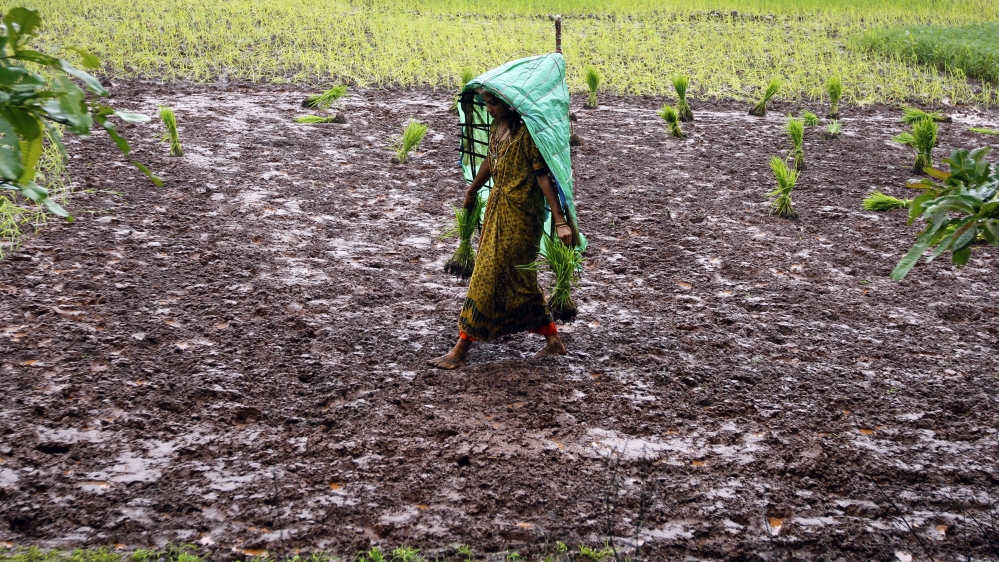
A farmer wearing a plastic sheet to protect herself from rain, carries saplings to a paddy field on the outskirts of Saputara hill station, about 400 km (249 miles) south from the western Indian city
More than 4,500 young women in Beed are believed to have undergone early and possibly unnecessary hysterectomies [File: Amit Dave/Reuters]
Vrandavani Sandeep, 36, from Umrad Jahagir village, had a hysterectomy two years ago.
"Given the water shortage, work is scarce. We cannot afford to lose it over our female problems," she told Al Jazeera.
Several women in the villages of Beed district referred to their "female problems", a euphemism for menstruation - still largely a taboo subject in rural India.
Periods are viewed by some sections of society as making women impure, and they are banished to live in menstruation huts.
They can't enter temples or kitchens, and can't touch anyone.
While several of these "traditions" are still practised in India, the subject has entered the national discourse with campaigns such as Menstrupedia and Girls Glory, along with the release of the commercial Bollywood movie Padman and the Oscar-winning documentary Period-End of Sentence.
Usha, the community health worker, said: "Taboos are being shattered through awareness programmes. Though, we still have a long way to go when it comes to basic hygiene, access to proper drinking water and nutrition."
I encourage my wife and daughter to talk to me. I lost my sister to uterine cancer because she kept the problem to herself.
UDHOVITTHAL KUTE, FARMER FROM VAJARANTWADI
Through ASHA sisters, women in rural India are meant to have easier access to free pads.
But women in Beed villages complain that this has not been the case. 
Radha Mugle, a 28-year-old from Hajipur who is preparing to have her womb removed, said: "The ASHA sisters hardly receive stock and it's difficult for us to be able to afford it ourselves."
The average cost for a pack of 12 low-cost sanitary pads is 100 rupees ($1.45) in Beed.
Reflecting on her own hysterectomy, 60-year-old Gayabai Mugle said: "I was unable to get up during my period and would often get infections."
Sitting on a charpoy in a thatched hut, she now understands that these complications may have been because she used cloth instead of a sanitary pad - something that is still practised in several pockets of the country, and because she was unable to discuss her menstrual ailments with anyone.
However, the conversation around menstruation has begun in some parts of Beed.
"I encourage my wife and daughter to talk to me. I lost my sister to uterine cancer because she kept the problem to herself," said Udhovitthal Kute, a 43-year-old farmer from Vajarantwadi, whose wife Ayodhya had a hysterectomy two years ago.
[Devyani Nighoskar/Al Jazeera]
Gayabai Mugle, 60, with poses with her daughters-in-law. She was unaware that using a piece of cloth during menstruation instead of a sanitary pad caused infections. [Devyani Nighoskar/Al Jazeera]
The National Commission of Women has alerted Maharashtra Chief Secretary UPS Madan, following a report in The Hindu Business Line, calling for legal action to "end the menace of womb removal". 
A special committee was formed on June 18 under the Maharashtra legislative assembly.
"The seven-member committee comprises of doctors, health workers, researchers and human right activists. The committee would be carrying out surveys and formulating a plan to put an end to this practice. The report is anticipated in mid-August," said Dr Radhakishan Pawar, district health officer from Beed district. 
Education for women often isn't a priority in Beed.
The lack of schooling leaves farm work as the only option and fails to provide them with knowledge of their rights and the hysterectomy procedure.
Most quit school after they hit puberty. Some are forced to because their families can no longer afford the fees.
With no other skills or schemes directed towards women, they start helping out on the farms.
Manisha Tokle, a women's rights activist from Beed, said: "This is a serious matter and one solution for it is to make women aware of their bodies.
"Women who have undergone hysterectomies need to be provided follow up sessions."
In Umrad Jahagir village, 40-year-old cane-cutter Dwarka Sandeepan, reflects on the importance of education.
She is the only married woman in her family who has not had a hysterectomy.
"We need more employment schemes for women," she said. "Education is a must, too. How else will we know of our rights?"
SOURCE: AL JAZEERA NEWS

Wednesday, May 1, 2019

No games for women with 'too much' testosterone


Indian activist and researcher on gender issues in sports, Payoshni Mitra, talks about the case of Dutee Chand, an Indian athlete who was recently banned from competition due to naturally occurring high testosterone levels. Hida Viloria, an intersex representative at the IOC Commission follows with her take on the International Olympic Committee’s policy on testosterone testing. For the rest of the conversation, watch the full episode: http://bit.ly/1pKhkYK

Gender bending, gender testing by Vrinda Marwah

आज ओलंपिक धावक सेमेन्या Semenya को लेकर खेल जगत में चर्चा है. उनके शरीर में टेस्टोस्टिरोन हार्मोन की मात्रा लड़कियों में पाई जानेवाली निर्धारित मात्रा से अधिक है. इस आधार पर फैसला हुआ है कि उनको दवा खाकर अपने शरीर के टेस्टोस्टिरोन को घटाना पड़ेगा तभी वे महिला खिलाड़ी की श्रेणी में (ख़ास दूरी की) दौड़ प्रतियोगिता में हिस्सा ले पाएँगी. मालूम हो कि टेस्टोस्टिरोन लड़कों के लक्षण उभारनेवाला हार्मोन है. इस खबर पर पूरी दुनिया में फिर से बहस छिड़ गई है. पिंकी प्रामाणिक और दुती चंद का उदाहरण हमारे सामने है. मतलब यह है कि हाव-भाव, चाल-ढाल, पहरावे, केश-सज्जा आदि ही नहीं अब हार्मोन और क्रोमोजोम की जाँच करो और लड़का-लड़की के दो डिब्बों को बनाए रखो. कई साल पहले का यह लेख महत्त्वपूर्ण है.
The arrest and subsequent humiliation of Indian athlete and international medal winner Pinki Pramanik has violated her right to privacy, bodily integrity, and basic human dignity. It has also raised important and often sidelined questions about gender, sports and the way the world is organised. Twenty-six-year-old Pramanik was accused by her live-in partner of repeated rape and torture, and of being a man. She was arrested on June 14, 2012. She was not granted bail for 26 days, which she spent in a male cell in a West Bengal jail, and she had to undergo three gender determination tests at different state hospitals, because the necessary facilities were not available at a single hospital. An MMS clip, showing her in the nude while undergoing one of the tests, was leaked online and went viral. The district and sessions judge, while granting Pramanik bail on July 11, held that she was physically incapable of rape, and that the petitioner who alleged rape had been in a consensual live-in relationship with Pramanik for nearly three years. Pramanik was suspended from her job as a ticket collector with the Eastern railways; the suspension was revoked after her bail and she has now rejoined work. While speaking to the media, she alleged that, in police custody, gender tests were forcibly carried out on her after drugging her and tying her hands and feet.
In November 2012, the West Bengal police submitted a chargesheet before the district court in which, citing medical reports, they alleged that Pramanik is indeed male, and charged with rape. Later, Dr BN Kahali, who headed the medical investigation into Pramanik’s gender, clarified that Pramanik suffered from a “disorder of sexual development”, and could best be described as a male pseudo-hermaphrodite, which is to say that Pramanik is not female, but “cannot be termed a male”. Pramanik has responded by saying she feels “like a joker in a circus”, and is being driven by the police to think of suicide. According to the latest media reports (also in November 2012) Pramanik planned to file a defamation case against the police and the public prosecutor, and publicly asked West Bengal Chief Minister Mamata Bannerjee, and the union sports ministry, to intervene in her case.

Saturday, October 6, 2018

Importance of 377 Judgement by Chayanika Shah

जब तक हम सब आज़ाद नहीं, हममें से कोई आज़ाद नहीं: 377 फ़ैसले की अहमियत, हर भारतीय के लिए

(अंग्रेज़ी से अनुवाद: स्मृति नेवटिया)
by Chayanika Shah
पृथ्वी के कोनों तक बिखरे हमारे जैसे कई लोग हैं जो पच्चीस सालों से चल रही लड़ाई के अपने समाधान पर पहुँचने का आज एहसास कर पा रहे हैं. 2013 में सर्वोच्च न्यायालय से मिले झटके के बाद ऐसे शब्द सुनना कि कौशल मामले में दिया गया निर्णय आज से रद्द हुआ और भारत में हमजिंसी रिश्तों पर से अपराध का साया हट गया है, यही हम लम्बे संघर्षों के अनुभवी-आदी कार्यकर्ताओं को आगे चलते रहने की हिम्मत देता है. इन छोटी-मोटी जीतों के बल पर हम जीने की उस राह की तरफ़ बढ़ रहे हैं जिसपर हमारा संकल्प यही रहेगा कि 'जब तक हम सब आज़ाद नहीं, हममें से कोई आज़ाद नहीं'.

हालांकि आज संवैधानिक पीठ से जो मिला है वह कोई मामूली फ़तह नहीं. जहाँ क्वीयर हक़ों की पूर्ती के लिए कुछ विशेष यौनिक व्यवहारों को क़ानूनी क़रार देना ज़रूरी है, अलबत्ता काफ़ी नहीं, इसे एक बड़ी जीत ही मानना होगा. यह ऐसा क़दम है जो संविधान की दृढ़ता का भरोसा दिलाता है, हमें विश्वास दिलाता है कि हमारा संविधान एक ऐसा गतिशील दस्तावेज़ है जिसे बदलते समय के अनुसार पढ़ते-समझते रहना होगा, और साफ़ ज़ाहिर करता है कि अल्पसंख्यकों की रक्षा करना अदालतों की ज़िम्मेदारी है, भले ही उस समुदाय की तादाद कितनी ही न्यून क्यों न हो.

Tuesday, March 13, 2018

Friday, June 30, 2017

Maya Rao at NOT IN MY NAME (delhi)


Not In My Name

In the name of a cow, my cow, you strike a knife through me
And In the name of Make in India you make me run, 
snatch the food from my mouth, 
chase me out of my home…..
One day, in the name of Jaimata you’ll drive, 
Drive, drive a tank hard over me

Swachch bharat ke naam pe mera safaya kar loge?
Chasme pe likh doge, tho Gandhiji ko Samajhjaoge?
Paliya Swachchta, Swadeshi, Swaraj, Ram Rajya?

Tum kya jano Ram ka naam?
Tum kya jano Siyaram?
Tum kya jano,
No, you’ll never know
What Jesus died on the cross for
What the Prophet fled his home for
What Budhha’s 8-fold path was
That Ram’s other name
That we greet each other
Every morning….
Jai Siyaram Jai Siyaram

That simply writing on Gandhi’s spectacles
Gives you not sight, no vision
Blind Blind
Turning a blind eye is a far, far cry from turning the other cheek
Theek?

Izzat bachane ke nam pe
Bataoge mujhe kya pehnna hai?
Saath kiske rehna hai, Dua kisse mangna hai?
Gau raksha ke naam pe roti mere haath
se chheen loge?
Chuppi saadh ke muh modloge?

Aur nahi, mere naam pe nahi
Chchoona mat mere chasme, kehte hain Gandhi

Yes don’t you dare
Not in my name
But don’t you dare
In the name of Allah, Krishna, Buddha, Jehovah,
Kalburgi, Pehlu Khan, Dhabolkar, Mohd Akhlaq, Pansare….
Junaaaaaaid

One last kiss….

You hear? Can you hear?
How come not a sound escapes your, their lips

In the name of making your India

28 Sept.2015 – 3 days after Eid 
Mohammad Akhlaq, a farm worker, asleep in a room next to his 22-year-old son, Danish


2015
7 days after Gandhi’s birthday, Zahid Rasool Bhatt, petrol bombs thrown on his truck

2016
Jan. 14 On the very day of Makar Sankranti, Pongal, Bihu several passengers on a train attaked, Harda distt, MP

Feb. 20 Muslim cops trashed, forced to carry a saffron flag, chant Jai Bhawani

You’ll make me run, snatch the food from my mouth, chase me out of my home, kill my son on a train…

For him one last kiss
All he had in his bag were gifts

Not in my name
Mere nam pe nahi
Lelo chashme wapas,
you hear him?.... Gandhi


In the name of making your India you’ll make me run, snatch the food from my mouth, chase me out of my home, kill my son on a train, slit my brother’s neck in a truck…..

2016
6 days before Holi, 2 cattle traders hanged

2016
Apr 5, 10 days before Ram NavamiMustain Abbas shot dead
2016
7 days before Ind. Day two brothers in Andhra tied to a tree, thrashed for skinning a dead cow
2017
Apr 1, 13 days before Ambedkar Jayanti, Pehlu Khan
attacked, died, for illegally transporting buffalo

you…you…you

Don’t you dare take my name
Not in my name, never in my name

When all he did was save his cattle from
dying on the streets, make shoes,  sell her,
feed his family, keep them from dying
in the streets.
When all he had in his bag were sweets,
gifts for his sister, brother, mother.
Will you wipe us all clean?

Bass
Bilkis
Where are you, Bilkis?
One last ….

In the name of making your India you’ll make me run, snatch my cattle, my  food from my mouth, chase me out of my home, kill my son on a train, slit my brother’s neck in a truck,…..you…you…you

You can you hear?
Does a sound….

All in the name of a cow
My cow
Not your cow, my cow
For her I gave hard earned money,
Fed her, cared for her, milked her
And when she’s ready to go
You'll let her die on the street,
Let her bleed, let me bleed?

Not in my name
No no no, not in her name
Chashme pe likh lete ho to samjh lete ho
Nazar pa liya?
You turn a blind eye
I’ve turned my other cheek
Time after time
Theek?

So it's like this -
If I’m a student, whose brother wears a uniform and fights for his country you throw fake video tapes in my face and tell me, we’ll teach you who a patriot is

If I’m a woman you tell me wear what we tell you, walk when we tell you, marry who we tell you,
you asked for it so raped you will be

If I’m a farmer you tell me - jai kisan nahi, jai jawan

If I’m a child you tell me it doesn’t matter, you don’t need to know who your first prime minister was,
I’ll give you fresh spectacles, read what I tell you.

If I’m a nobody you’ll still get after me
Tell me what to eat, who to meet, when to play
Hey, I say -
You’ll never know my name
Yes, you’ll never know my name!

If I’m a cow you’ll let me die on the street,
Let me bleed, my master bleed
Feeeed, what do you feed on?
breeed, do you only breed…… hate?

Not in my name
Don’t you dare
Not in that child’s name
You’ll never know that child’s name

Mere naam mere naam pe nahi, kabhi nahi
Lelo Chashme wapas, hear him? Gandhi

You hear? Can you hear?
How come not a sound escapes their  lips
For him one last kiss
Not in my name…bass
All he had in his bag were gifts
Sab ke saath, sab ka vikas
Bassss

So, so so I pray,
Oh god, may I be born next a goat,
not a cow, not  human,
You won’t chase me, lynch me, teach me, bleed me

Make me, make India,
Apr. 21. 7 days after Ambedkar Jayanti, a family, a small girl elderly attacked, beaten in J&k

And it goes on….
June 22, 4 days before Eid, Junaid….

June 27, yesterday, Usman Ansari, Deori, ranchi, thrashed
For a dead cow found outside his housssssse
Basssss

Don’t you dare
Not in her name, not in mine
Not his, not hers
Don’t you dare
All he had in his bag were gifts
His, hers, yours, theirs

You kill in the name of country

Stand up, Stand up India
Look, there’s Saira
There’s Bilkis, there’s Dhabolkar, Usman Ansari, 
Pehlu Khan, Pansare
Junaaaaaaid

Yes in his name, in hers, Bilkis
In his and hers, and ours
Get on a train, a truck, walk into the park,
Fill the streets
You hear….can you hear?
There’s a roar….. a shor
Today in my name
A last kiss

Bass
They shall not pass

(give many flying kisses….at the last one -)

Don’t you dare - you’ll never catch that kiss


Maya Krishna Rao
Performance made - Jun. 27-28, 2017
Delhi


http://mayakrishnarao.blogspot.in/p/about-maya.html