जेंडर संसाधन

जेंडर और शिक्षा से जुड़ी संदर्भ सामग्री बिखरी हुई है. उनमें से चुनकर इकट्ठा करने का प्रयास है.

Showing posts with label Economy. Show all posts

Thursday, July 25, 2019

Indian female farmers going 'womb-less' to boost productivity by Devyani Nighoskar 24 Jul 2019

Despite national awareness campaigns, menstruation is still a taboo subject in India and impoverished people are most at risk [File: Reuters]

MORE ON INDIA

  • Q&A: Was Pakistan PM Imran Khan's visit to the US a success?today
  • India running out of time to cash in on demographic dividendyesterday
  • India probes as no girl is born in three months in 132 villages2 days ago
  • Indian FM denies Modi asked Trump for US mediation on Kashmir2 days ago
Maharashtra state, India - Pushpa, a farmer and mother of two, was 26 when she experienced heavy bleeding during her period and abdominal pain.
She took medicine for two years until a doctor advised a more serious "cure".
She soon became one of the many women in the villages of Beed district, which is in the Indian state of Maharashtra, to undergo a surgical procedure to remove her womb.
"It was not an easy decision to make. But my husband encouraged me to do it, because the pain affected my work. The hysterectomy caused some hormonal imbalance and I put on weight," said Pushpa, who is now 37. 
According to Indian media, more than 4,500 young women in Beed have had potentially unnecessary hysterectomies over the past three years. 
Activists and studies surveying affected women say there are socioeconomic reasons behind this phenomenon.
They claim that women are becoming "womb-less", whether voluntarily or coerced, for two main reasons. 
The first is that doctors are exploiting them, scaring them into believing that the expensive surgery is necessary and, therefore, turning a profit. The second is because of a perception that menstruation hinders work.
Beed is a drought-prone area, where sugar cane cutting is the main source of income.
During cane-cutting season, October to March, the women often rise at 4am to make food for their family. The working day then begins at 6am and ends at around sunset, 6:30pm.
Given the water shortage, work is scarce. We cannot afford to lose it over our female problems.
VRANDAVANI SANDEEP, FARMER WHO HAD A HYSTERECTOMY TWO YEARS AGO
Field work is rigorous and requires upper body strength. After the cane is cut, it is tied together. The women carry the loads on their heads.
If they need to urinate, they usually do it in the fields because longer breaks incur a fine.
Rukhmini Tandale, a 45-year-old cane cutter from Vajrantwadi village, went to a doctor in November 2018 in Beed city, and like Pushpa complained of abdominal pain.
The doctor told her having a hysterectomy would prevent cancer.
"I did think that an operation might just be a way to extract more money, but I didn't want to take a chance," she told Al Jazeera.
The average cost of a hysterectomy is 35,000 rupees ($508) in Maharashtra, a state where the daily wage for a female farmer is around 202 rupees ($2.93).
Almost 30km away, in Hajipur village, Lata Magar, another victim, said: "It was better to invest in operation at once than keep spending over medicines."
Women are often made to believe that their uterus is of no use after childbirth and are rushed into unnecessary surgeries.
"Some unethical clinics, whose main purpose is maximising business, advise hysterectomies by telling women that their ailment may turn cancerous. [But unnecessary] hysterectomies [may] also lead to other health issues," said Dr Shashikant Ahankari, president of the HALO Medical Foundation in Maharashtra.
[Devyani Nighoskar/Al Jazeera]
Eknath Devrao and Lakshman Sonawne are contractors for sugarcane farmers in Beed district. They usually employ a couple in a field and claim that they have never asked a woman to have her womb removed in order to boost productivity [Devyani Nighoskar/Al Jazeera]
Usha Raosaheb is a community health worker, known as an "ASHA sister", appointed by the government's Ministry of Health and Family Welfare, in Vajrantwadi village.
She countered the women's claims, telling Al Jazeera: "There may be some greedy doctors, but I know several women who undergo hysterectomies to become employable by contractors or more productive in their fields."
Farmers in Beed are usually hired by a contractor, who employs couples as one unit. 
Women who have a "pishvi", which means bag but is used to refer to a uterus, are seen as less employable.
Contractors employ the couple for a year and pay them an advance of about 1,50,000 rupees ($2,175). To earn it back, the women need to show up to work every day and some voluntarily undergo a hysterectomy to avoid their routine being impacted by their periods.
Bajinder Maan, a labour rights lawyer in Delhi, told Al Jazeera that he feared thewomen's human rights were being violated.
"They can certainly avail justice from the labour laws office in their district if they feel that their employers or contractors are forcing them into surgery, or showing a bias towards those women who have had a hysterectomy," he told Al Jazeera. "However, it may be challenging for the women to prove this claim in the civil courts because they are part of an informal industry, with no workable documents to establish the contractual relationship.
"Being part of a district farmer's union, affiliated to a political party, makes it easy to get redressals for such grievances."
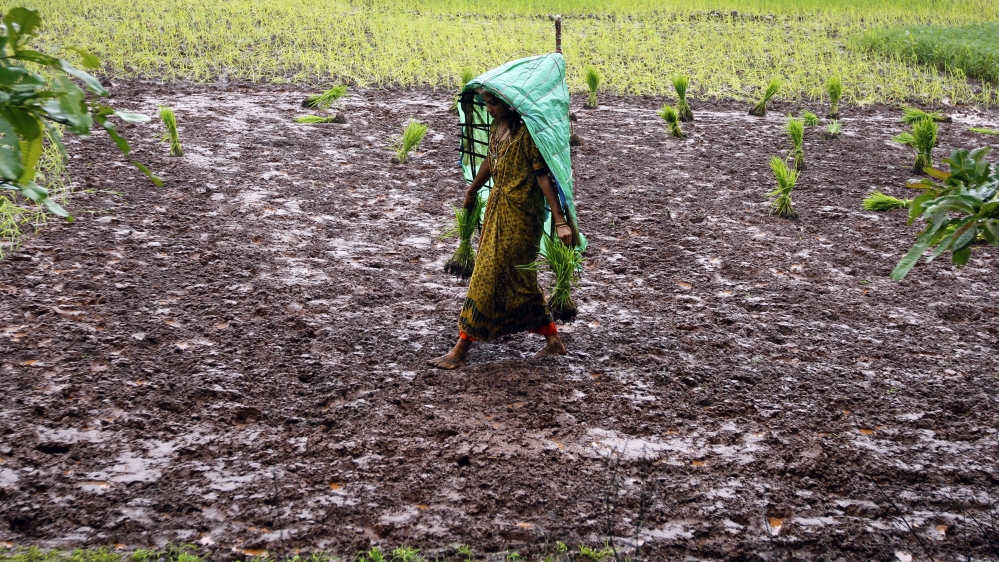
A farmer wearing a plastic sheet to protect herself from rain, carries saplings to a paddy field on the outskirts of Saputara hill station, about 400 km (249 miles) south from the western Indian city
More than 4,500 young women in Beed are believed to have undergone early and possibly unnecessary hysterectomies [File: Amit Dave/Reuters]
Vrandavani Sandeep, 36, from Umrad Jahagir village, had a hysterectomy two years ago.
"Given the water shortage, work is scarce. We cannot afford to lose it over our female problems," she told Al Jazeera.
Several women in the villages of Beed district referred to their "female problems", a euphemism for menstruation - still largely a taboo subject in rural India.
Periods are viewed by some sections of society as making women impure, and they are banished to live in menstruation huts.
They can't enter temples or kitchens, and can't touch anyone.
While several of these "traditions" are still practised in India, the subject has entered the national discourse with campaigns such as Menstrupedia and Girls Glory, along with the release of the commercial Bollywood movie Padman and the Oscar-winning documentary Period-End of Sentence.
Usha, the community health worker, said: "Taboos are being shattered through awareness programmes. Though, we still have a long way to go when it comes to basic hygiene, access to proper drinking water and nutrition."
I encourage my wife and daughter to talk to me. I lost my sister to uterine cancer because she kept the problem to herself.
UDHOVITTHAL KUTE, FARMER FROM VAJARANTWADI
Through ASHA sisters, women in rural India are meant to have easier access to free pads.
But women in Beed villages complain that this has not been the case. 
Radha Mugle, a 28-year-old from Hajipur who is preparing to have her womb removed, said: "The ASHA sisters hardly receive stock and it's difficult for us to be able to afford it ourselves."
The average cost for a pack of 12 low-cost sanitary pads is 100 rupees ($1.45) in Beed.
Reflecting on her own hysterectomy, 60-year-old Gayabai Mugle said: "I was unable to get up during my period and would often get infections."
Sitting on a charpoy in a thatched hut, she now understands that these complications may have been because she used cloth instead of a sanitary pad - something that is still practised in several pockets of the country, and because she was unable to discuss her menstrual ailments with anyone.
However, the conversation around menstruation has begun in some parts of Beed.
"I encourage my wife and daughter to talk to me. I lost my sister to uterine cancer because she kept the problem to herself," said Udhovitthal Kute, a 43-year-old farmer from Vajarantwadi, whose wife Ayodhya had a hysterectomy two years ago.
[Devyani Nighoskar/Al Jazeera]
Gayabai Mugle, 60, with poses with her daughters-in-law. She was unaware that using a piece of cloth during menstruation instead of a sanitary pad caused infections. [Devyani Nighoskar/Al Jazeera]
The National Commission of Women has alerted Maharashtra Chief Secretary UPS Madan, following a report in The Hindu Business Line, calling for legal action to "end the menace of womb removal". 
A special committee was formed on June 18 under the Maharashtra legislative assembly.
"The seven-member committee comprises of doctors, health workers, researchers and human right activists. The committee would be carrying out surveys and formulating a plan to put an end to this practice. The report is anticipated in mid-August," said Dr Radhakishan Pawar, district health officer from Beed district. 
Education for women often isn't a priority in Beed.
The lack of schooling leaves farm work as the only option and fails to provide them with knowledge of their rights and the hysterectomy procedure.
Most quit school after they hit puberty. Some are forced to because their families can no longer afford the fees.
With no other skills or schemes directed towards women, they start helping out on the farms.
Manisha Tokle, a women's rights activist from Beed, said: "This is a serious matter and one solution for it is to make women aware of their bodies.
"Women who have undergone hysterectomies need to be provided follow up sessions."
In Umrad Jahagir village, 40-year-old cane-cutter Dwarka Sandeepan, reflects on the importance of education.
She is the only married woman in her family who has not had a hysterectomy.
"We need more employment schemes for women," she said. "Education is a must, too. How else will we know of our rights?"
SOURCE: AL JAZEERA NEWS
Posted by पूर्वा भारद्वाज at 7:05 PM No comments:
Email ThisBlogThis!Share to XShare to FacebookShare to Pinterest
Labels: Body, Economy, Labour, Market, Women, हिंसा

Monday, July 17, 2017

Farm Ownership: The Dream - Story of a woman farmer


January 9, 2016 / Shannon

Farm ownership: it’s a farmer’s dream and often difficult to attain.  My project about women farmers started and blossomed with one such farmer with a fierce dream.
Shannon Varley is a woman with a strong vision of owning and working her own farm, and she’s been on a mission to realize that dream for years. I feel so fortunate to know her and to witness her dogged struggle to achieve her dream of being a land-owning farmer. She is a generous and warm person with a genuine heart, and she is an inspiration. It’s Shannon who one day said to me, “Lise, you should start a blog.” So, here we are. Thank you, Shannon.
I’ll be telling her story in small pieces over the course of many posts. It’s a story of a dream, of persistence, hard work and luck, of  tragic loss and of renewal.
In the four years alone that I’ve known and have been photographing her, I’ve seen her family go through many challenges in the quest to own their farm. Shannon has faced them all with inspiring grace and tenacity.
It took Shannon eight years of “searching and working and dragging animals up and down the East Coast” before she and her family found and purchased their own farm in Knoxville, MD—the farm, she laughs, out of which she’ll be carried feet first.

The appeal of a farming lifestyle

Shannon is married with two children. In the time I’ve known her, she’s lived in 4 different places and had a variety of farm animals: pigs, steer, chickens, sheep and rabbits (hope I’m not forgetting any) and two different gardens. Farming was never on her radar as something to do with her life, but over time she arrived at a place of knowing that farming was her true calling. She now feels that her role in growing and raising healthy food for people addresses many of the problems that we face as a country; at the same time, a farming lifestyle is how she wants to live and raise her children. It’s a life that is very hard, but feels right to her. At this point she can’t imagine doing anything else with her life, even though she often toys with the idea of returning to some kind of 9 to 5 job, because “Lord knows we could use the extra money!”
Shannon Varley's son plays with steer in fieldBut a 9 to 5 kind of life doesn’t feel intuitive to her, and Shannon listens to her intuition. She’s learned through the years that when she approaches the world with a heart of love, warmth and trust, things really materialize the way they are supposed to.
But how did she arrive at this point of knowing, was my question. She didn’t grow up with farming as a model, so how did she find her way to it? Did she choose her path, or was she led to it? How did she know it was her calling?
The birth of a farmer
From an early age Shannon noticed how food affected how she felt, mentally and physically. By the time she got to college, she realized how important it was that people be growing healthy food, but it never crossed her mind that farming would be a viable option for her. What seemed viable for her, instead, was to focus on policy and lawmaking as the way to have an impact. After researching a project on organic standards at Denison University, she became curious about farming and took a post-graduate internship at Malabar Farm in Ohio, where Louis Bromfield, considered the father of the sustainable farming movement, had lived.  It was her first exposure to farming, and she felt attracted to its vibrancy and deepness. And its chaos.
After about six months of interning on the farm and working part time as a naturalist, she made what to me seems like a remarkable decision for a young woman. In 1999 she approached an older man with aShannon Varley holds tomato seedlingsvacant farm and asked if she could lease the farm and make a go of it. She stood on his doorstep and explained that she wanted to grow organic food and start a CSA, but Shannon could tell he clearly wasn’t listening to anything she was saying. He scrutinized her and said, “You’re not going to grow wacky tobbacky, are you?” After explaining that she would not be growing marijuana but was, indeed, just interested in growing vegetables—and after explaining what “organic” meant—he agreed to lease her the farm. Once she won him over (which I can imagine didn’t take very long), he became a huge supporter, loaning her equipment, plowing her fields. She had free range of his greenhouses. Whatever she asked for, he gave her. What a nice situation in which to learn farming!
Shannon Varley's garlic curing after harvestShannon quickly realized, though, that even with his help she couldn’t do it by herself, so she convinced a girlfriend from Malabar Farm to come join her. They farmed two acres, started a CSA in Columbus, sold to restaurants, and both had part-time jobs. For two years they worked their butts off, and Shannon enjoyed it. But she was young, was living in the middle of nowhere, and still wanted a social life, so she and her friend decided to move away from the farm.


Choosing a Life’s Path: Shannon Varley Part 2

January 9, 2016 / Shannon.

Shannon left her two-year stint at farming without a clear idea of what to do next. So like any good child of teachers, she returned to school. She had always felt that meaningful change in our food system would come about on the policy level, so school was the natural place for her to be. While at Vermont Law School working on her master’s degree in environmental law, she was unhappy being stuck inside. She was aware of the changing seasons and would think, “this is when I’d be planting such-and-such.” She was constantly distracted from her schoolwork by spending time outdoors, by a desire to watch the changing light and the sun’s position in the sky.
Shannon Varley sleeping pigs in sun
Shannon realized that all her time pursuing academic work was like checking off boxes (undergraduate: check; master’s: check), and she felt disconnected from what was intuitive and natural and right for her. After law school, feeling more lost than she’d ever felt, she returned to her parents’ in Pennsylvania to start job searching, hell-bent on finding a policy position in DC, even though that kind of work didn’t quite resonate with who she felt she was. She sees now that she just wasn’t listening to herself.
I’m sure we can all relate to that feeling of being lost in our lives and not knowing how to proceed. I think often about the question of whether we determine the course of our life or whether we are led to discover our path. When I listen to Shannon tell her story, I definitely feel she was led. So does she.
Shannon trades in her power suit for Red Wiggler
While helping a neighbor look for a program for her son, she came across Red Wiggler Community Farm in Maryland,  a program that integrates farm work and job training for developmentally disabled adults. That same day—really, the same day—she noticed an opening on Idealist for a farm manager at Red Wiggler, and despite the fact that the job didn’t entail wearing a suit in the corridors of power in DC, something about it felt right to her. You can guess what happens next, right? She gets the job and moves to Maryland in 2003.
Shannon Varley holding a chicken
Shannon loved her job and was able to take part in all aspects of the small operation, greatly expanding her skill set. She worked on the farm for five years. During that time she met her future husband, BJ, and pretty quickly they had a daughter. She was able to bring her daughter to work with her, which was a joy, and her job duties shifted into grant writing and other administrative tasks. By the time her son was born two years later, she was doing contract work for Red Wiggler from home.
By now she knew—deeply knew—that she wanted to be farming. Screw the corridors of power! She felt that farming was something she could do with the kids in tow and it would be a life that was right for her family. BJ had a business restoring barns, and Shannon felt sure that being the frugal people they were, they could live on BJ’s salary and get a farm going.
Shannon_Varley_sheep_050
So what, exactly, does that look like? Starting a farm from scratch seems like an overwhelming and heroic proposition. Even more so when you have the responsibility of raising children. I’ve learned, though, that like everything else in life, you take it one step at a time and you learn as you go.
First step for Shannon: find some land.


Moving to Vermont: Shannon Varley Part 3

January 14, 2016 / Sh, Uncategoriz

After Shannon’s children were born, she again felt the strong pull to farm her own place. She knew it was the lifestyle that she wanted for her family, but she wanted to be having it on a farm she owned herself. She and husband BJ decided that they’d have a better chance of finding a large farm in Vermont, and it would be a more suitable place in which to raise their kids. They moved the family in the summer of 2008 but soon found that they were mistaken about the likelihood of affording the 100-acre farm to which they aspired.
Shannon_Varley_deer_target_221
Instead they bought a cottage with four acres. Shannon grew vegetables and started a farmer’s market in an open public space in town, inviting other farmers to sell there as well. That market is still going strong. From what I know about Shannon, I would have thought that the life she had in Vermont would have been her dream. And in many ways it was, but as her kids grew older, both Shannon and BJ missed having immediate family around.

Back Down the East Coast

Shannon Varley feeding her pigs
Shannon uses her Volvo to bring feed from the barn down to the pigs.
BJ’s gift is restoring timber barns, and before they had moved to Vermont, he did a large restoration project for a family in Maryland. (I’ve seen the barn, and it’s a spectacular restoration.) That family contacted Shannon and BJ in Vermont to see if they might be interested in renting a neighbor’s 15-acre farm. The farm wasn’t far from where BJ’s family lived, so in 2010 they packed up and moved back down.
Shannon Varley chicken coop.
Once back in Maryland, Shannon called her farm Bella Terra Family Farm and grew vegetables and raised pigs, steer and chickens. She started a local CSA and also sold at three farmer’s markets.
It was during the time Shannon was renting the Maryland farm that I first met her. She spoke often and passionately about the importance of connecting willing farmers with good farmland, and about how hard it is for farmers to afford land.
Shannon Varley's garden in fall, after the last harvest.
I spent many days at Bella Terra, photographing Shannon as she worked and getting to know her. One of my favorite days was a foggy day just before Thanksgiving, when most of the images on this post were taken. Fog is one of my favorite weathers to shoot in. I love the softness, the quiet and the muted colors.
For Thanksgiving, Shannon had posted on the dining room wall a large piece of paper that read Grateful. She and BJ and the kids posted what they were grateful for. What a lovely annual tradition.

Shannon Varley family gratitude poster.

Farm Ownership: the Dream Remains

Shannon liked her little farm, but her dream for eight years had been to own her own place, not rent, and she couldn’t let the idea rest. Some people argue that a long-term lease is a viable option to get farmers on the land, but Shannon says she’ll never back down from her belief that from the point of view of financial sustainability and land stewardship, it’s essential that ownership be a possibility. She is passionate about this topic.
Finding good, affordable farmland is a challenge, though, because at least in this part of the world, land is sold at development prices, not farm prices. The part of affluent Montgomery County where Shannon was renting had once been rural farmland, but over time the farms were developed for people wanting the feel of the country only 40 minutes from downtown Washington, DC. In came the McMansions. Shannon’s little house and gently sloping property lay nestled among them, practically swallowed up.
The desire to own her own place was palpable, she told me, and sometimes it kept her up at night. But how on earth could they afford a place?


Buying a Farm: Shannon Varley Part 4

January 20, 2016 / 

For eight years, Shannon’s goal was to own her own farm, and she and husband BJ visited, walked, and mulled over many, many farms for sale in Maryland, but nothing was quite right. Little did Shannon know that one particular trash-heap of a place would end up being her farm. On her first visit to the property, Shannon wouldn’t even get out of the car. All she saw from the car was a neglected, run-down property that had been completely trashed. Apparently whoever had most recently lived there had not believed in garbage cans but chose instead to throw trash anywhere around the yard. Months after buying the property, Shannon was still finding empty cake cartons in the woods behind the house.
In retrospect, Shannon now likes to say: “sometimes great opportunities are missed because they are dressed in overalls.” Despite her resistance, BJ had a hunch about the trash-heap place and kept bringing it up to her. (Hmmm, there’s that intuition thing again.) Except whoops…opportunity gone. Someone else had made an offer and the property went off the market. Soon, though, it reappeared at a reduced price, and Shannon agreed to at least have a get-out-of-the-car look at it. This time the yard had been cleaned up—a little—at least to the point where she could get her head wrapped around the idea and start to establish a vision for the place.

The Dump

What the property had going for it was a large barn in back that was in great shape. There was some fencing in place, a lovely little pond, and enough land for livestock. She thought that making a good farm out of it was conceivable, and they decided to go for it. They bid low, knowing how much work they’d have to put into the place. Eventually, after lots of back and forth, they secured the property at a reasonable price. That was in April of 2012.
Shannon Varley's barn sits next to a McMansion
The barn. Notice the McMansion neighbor.
Most important, and what made the deal even possible, was that they were able to finance the purchase for the value of the land alone, because the 1820 house was considered a tear down. “A dump” and “uninhabitable” was what the appraiser called it. The original house was a log cabin, with a stone addition added sometime after, all of which was covered with filthy layers of plaster and drywall. But BJ, whose specialty is restoring timber-framed barns and old houses, suspected that underneath the grime lay a sweet treasure.
But good grief, how would they tackle a job that Shannon said was “overwhelming and more overwhelming”? Shannon described what needed to be done as “the extraction of every inch of plaster, drywall, moldy insulation, flooring, snakes, and anything else that happens to fall out of ceilings or walls. It involves the extensive use of respirators and thick work gloves. It’s a nasty, nasty dirty job.”
And not exactly spending time outside tending to animals or vegetables. But still, a farmer has to have a place to live.
Shannon Varley renovation farmhouse
Removing the disgusting plaster from the original log cabin
Shannon Varley 1820 log cabin farmhouse under renovation
Shannon and BJ had poured all of their money into the purchase of the farm, so they relied on friends and family for help. They had work parties, and on the first weekend alone, a generous group of folks got more done than Shannon and BJ could have accomplished in a month of weekends.
I wish I could say I was at that party to help and to document the process, but I wasn’t. I didn’t reconnect with Shannon until they were three months into the renovation. While they worked on the house, they lived in a trailer parked just up the driveway. The first time I went into the trailer, to use the bathroom, my thought was “Bless you, Shannon. I don’t think I’d last two days in here without losing my mind.” It was, of course, small and cramped, and they were two tall adults and two children. But to their everlasting credit, they survived 21 months living in that thing.
Shannon Varley farm house under construction
The house under renovation and a trailer to call home
Shannon Varley farm renovation
This was the dining room during renovation

A dream come true

They moved into the renovated house right before Christmas in 2013. In Shannon’s words, “I will never, ever, ever take for granted again: living space over ten square feet, indoor plumbing, an HVAC system, and the pure bliss of being able to close a door.”
And was BJ right about the house? Was it indeed a sweet treasure? Yes, absolutely and completely. Shannon credits BJ with taking “decades of neglect and transforming it into a work of art.”
Shannon Varley restored farmhouse, front door with wreath
Fortunately I was able to be at the grand housewarming party in January of 2014, and I couldn’t believe the transformation. The original log cabin had been revealed; there was a huge and inviting kitchen with stone walls and a deck off the back that overlooked the barn; BJ had rescued a fabulous claw foot bathtub from a hospital in West Virginia; and the bedrooms upstairs were lovely and snug. It had become a dream house. And it was featured in the October 2014 issue of This Old House.
Shannon Varley Rumi quote
The quote from Rumi written above the back French doors perfectly reflects Shannon’s spirit
Shannon’s dream had finally, thankfully, gratefully come true. Eight years of slogging through moves and renovations and mud and dirt and hard work and raising kids and animals and all of it—so much determination and grit. It was a joy to behold.
Now she could finally turn her full attention to her farm and building up its infrastructure.
Shannon Varley feeds her sheep   
  • ABOUT THE PROJECT
  •  
  • RESOURCES
  • SUBSCRIBE
  •  Unbearable Loss: Shannon Varley Part 5
    January 27, 2016 / Shannon

    I visited Shannon a few times after they moved into the finished house. I got to see her give pedicures to her sheep (meaning: cut their toenails and get covered in sheep dung), watch a sheep shearing done by a traveling woman shearer, watch Shannon put in her family garden (a larger market garden would be planted the following year), and generally hang out with the pigs and sheep and chickens and listen to Shannon’s plans for the farm.

    But on December 12, 2014, exactly 11 months after the grand unveiling of the remarkable renovation, the house burned down in a raging fire.
     photo courtesy Shannon Varley
    photo courtesy Shannon Varley
    As in: burned…to…the…ground. As in: everything lost. Their clothes, the kids’ toys, the furniture, Shannon’s grandmother’s china stored so cozy in the cabinet, the Christmas decorations the kids were making. Everything. Including their dog and cat.
    Shannon Varley's Grandmother's china
    This is the part of Shannon’s story that is almost too painful for me to tell.
    Here’s what happened. Shannon needed feed for the animals, so she and the kids made a trip to Frederick. BJ was at work. While they were gone, the dog knocked over a lamp inside the house, which started a fire. BJ arrived at the scene first, alerted by a coworker who had been driving by. By the time BJ reached Shannon on her cell phone and she made it back,  fire trucks blocked the road and her access, so she had to circle all the way back around the mountain to reach the house.
    When she arrived the house was engulfed in flames and all she could do was stand and watch. As she watched her house and dream burn to the ground, she says she began to laugh maniacally. “After all we’ve been through, this happens? How fucking hard does it have to be to have a farm?”

    Grief and gratitude

    After the maniacal laughter, the shock and incredulity, the tears came. Shannon says she cried a lot (I mean, who wouldn’t?) and had many, many sleepless nights. But here’s the inspiring thing about this truly remarkable woman. She says that 10% of her crying came from loss and grief, but 90% of it came from gratitude.
    Shannon Varley's burned farmhouse being razed.
    It continues to move me that she can access gratitude in the face of such unbearable loss. Here’s the Facebook post that she sent out just five days after the fire:
    “The enormity of compassion, kindness, love, and grace that has poured into our lives leaves us speechless. Tenderness has come from the most unexpected places. We are humbled. We have had to go down into our grief the last few days, which is the only way to go so that we can come up and out of it. It was just a house, yes, but many of you know it was so much more. It was our heart, our hands, the effort and time of so many people that love us and wanted to see our farm dream become a reality. After years of chasing it. This has become a cold, hard lesson in the art of letting go. It has also given us an unexpected gift. It has shown us over and over again, the beauty, grace, & selflessness of the human spirit: of so many of you. Words will never do this event or the range of emotions it has invoked justice. We have needed to know that you are there rallying around us: the calls, texts, e-mails, messages, hugs, thoughts–we have needed them all. I am sorry we have not been able to respond. We will as soon as we can. I want to say “thank you” from the deepest places of my and BJ’s heart. We are ok. Life carries on. There are far greater griefs in the world. We wrap our arms around each other and give thanks.”
    And we hold you in our hearts, Shannon.
    Spending time with Shannon while she worked has been the start of my education about farming, and she has been tremendously generous with her time and knowledge. Just being on her farm with her has helped soothe some tough patches in my own life. She’s an inspiration to me and a dear friend, and I can’t read her words about the fire without crying all over again.
    Shannon Varley's straw hat


    Moving on After Grief: Shannon Varley Part 6

    February 3, 2016 / Shannon
    After Shannon’s house was destroyed by fire, she said they received so many donations of clothes and household items that she needed help to go through them all. She said she now owned nicer clothes than she ever had before. I saw her about five weeks after the fire, and she said she felt deflated, ungrounded and untethered (and who wouldn’t?). But she also seemed philosophical and balanced about the experience.
    She said that she felt the path was being laid out for them, yet she wasn’t sure yet where that path would lead. What they needed first, of course, was a place to live. After ten days staying with family, they moved to a fully furnished rental. After going back and forth with ideas of rebuilding (some days BJ wanted to, some days she wanted to), they made the decision not to rebuild, but to move on.
    They listed the farm for sale (the house was gone, but the barn and fencing remained), and it sold within a week to a family excited about farming. They bought another dilapidated house (this one had been a crack house) right outside of Brunswick, MD, and BJ set to work renovating the house.
    They still owned their small place in Vermont, which they had been renting out since moving to Maryland in 2010. Their tenant moved out quite suddenly, and so the idea of moving back to Vermont entered the conversation. Over time they decided that once BJ had finished the renovation of the house in Brunswick, they would sell it, make a profit, and return to Vermont.
    I asked her if she could see herself being happy if she weren’t farming, and she said that no matter what, she would always have animals and a garden, but the scale of the plan was up for grabs. She felt jaded about farming, and resentful. “We have worked harder than most people in their whole lives for this dream.”
    “Fate is a weird thing. You don’t have profound things happen like this without something coming out of it. But is this how the story ends? A two-acre little house? It has got to have a better ending.”
    Dramatic sky looms over a rural Marlyand farm landscape

    Moving on

    Shannon ended up taking the kids up to Vermont in October of 2015, while BJ stayed behind to get the Brunswick house sold and finish a large barn project for a client. He will join the family when all of that is settled. (In typical BJ fashion, the renovation on the former crack house was stunning.)
    She wrote me that she and the kids jumped right in and hit the ground running. The kids’ school “is amazing, and has been the best thing for both kids.” Shannon is coaching the school’s 5/6th grade girls’ basketball team, and both kids are taking part in the school’s ski program this winter. They love their community and have a good group of friends.
    And the dream of a farm? “We have looked at a few farms up here but nothing has quite fit the bill yet. That feels discouraging. But, it will work out. I hope. I will fling myself on the ground of the farm when we land and kiss the ground.”
    Shannon was back in Maryland recently for the Future Harvest CASA conference, this year as a Future Harvest employee and not an attending farmer (she’s been working as a program assistant for them and helped organize the conference). It was momentarily disorienting to see her in a professional skirt, working at a conference. At one point I asked her if being at a farmer conference was difficult for her, now that she didn’t have a farm. She flashed a smile at me and, with a twinkle in her eye, said “It’s okay, because I know it’s coming.”
    A farmer's workboots sit outside the door.
    Let’s hope that soon these boots will rest outside a new farmhouse for Shannon.
     http://groundedwomen.com/
    http://groundedwomen.com/farm_ownership/
    http://groundedwomen.com/choosing-a-lifes-path/
    http://groundedwomen.com/moving-to-vermont-part-3/
    http://groundedwomen.com/shannon_varley_buys-a-farm/
    http://groundedwomen.com/unbearable-loss-part-5/
    http://groundedwomen.com/moving-forward-after-grief-shannon-varley-part-6/
    Posted by पूर्वा भारद्वाज at 3:32 AM No comments:
    Email ThisBlogThis!Share to XShare to FacebookShare to Pinterest
    Labels: Culture, Economy, Women, जेंडर, विश्व
    Older Posts Home
    Subscribe to: Posts (Atom)

    Total Pageviews

    Labels

    • Art
    • Body
    • Community
    • Culture
    • Desire
    • Economy
    • Education
    • Food
    • Labour
    • Language
    • Market
    • Media
    • Nation
    • NE
    • Photo
    • Sex
    • Social Structure
    • Sports
    • Video
    • War
    • Women
    • इतिहास
    • कानून
    • जेंडर
    • पितृसत्ता
    • यौनिकता
    • विज्ञापन
    • विश्व
    • संस्था
    • साहित्य
    • हिंसा

    Blog Archive

    • ▼  2025 (1)
      • ▼  August (1)
        • पढ़ लिख के बबुनी (Padh Likh Ke Babuni From AKSHARA ...
    • ►  2023 (1)
      • ►  June (1)
    • ►  2022 (2)
      • ►  October (1)
      • ►  June (1)
    • ►  2020 (2)
      • ►  September (1)
      • ►  January (1)
    • ►  2019 (9)
      • ►  August (2)
      • ►  July (1)
      • ►  May (3)
      • ►  April (3)
    • ►  2018 (4)
      • ►  October (2)
      • ►  May (1)
      • ►  March (1)
    • ►  2017 (75)
      • ►  October (3)
      • ►  August (1)
      • ►  July (5)
      • ►  June (6)
      • ►  May (1)
      • ►  April (9)
      • ►  March (27)
      • ►  February (23)

    Popular Posts

    • Hormones Ki Jaankaari by Agents of Ishq
      https://www.youtube.com/watch?v=asedba0SRcE
    • "करिहा छमा छठी मैया भूल चूक गलती हमार ..." (Chhath video : Gender analysis by Purwa Bharadwaj)
      https://www.youtube.com/watch?v=DG 8 F-csoRAQ ' पहिले पहिल छठी मैया '  यह पिछले साल का वीडियो है ,  मगर मैंने अभी पिछले महीन...
    • Performance artist stood still for 6 hours to let people do what they wanted to her body - Faye
      https://www.elitereaders.com/performance-artist-marina-abramovic-social-experiment/  Marina Abramovic ... about Rhythm 0 and Pen...
    • The New Vicks Ad Featuring a Transwoman and Her Daughter Hits All the Right Spots By Sharanya Gopinathan
      Still from Vicks India Youtube. Maybe we’re a little late to the party, but have you seen the new Vicks ad? It hits all the right spot...
    • EIC : 'Government approved' Sex Education in India
      https://youtu.be/EiIxkOah09E
    • Bhanwari Devi: A Hero We Failed By Maduli Thaosen
      This essay is part of the  #IndianWomenInHistory  campaign for Women’s History Month to remember the untold legacies of women who sh...
    • Three craters on venus are named after three Indian women - Sandhya Ramesh
      इस खबर के साथ सीधे ध्यान गया रमाबाई के नाम पर. रमाबाई ने अपना नाम कुछेक जगह ही पति के नाम के साथ जोड़कर रमाबाई मेधावी लिखा है. बीच में ईसा...
    • The Atlas Of Beauty by Mihaela Noroc
      Romanian photographer Mihaela Noroc spent nearly four years shooting portraits of — and collecting stories about — women from around the...
    • Shamsia Hassani, First Female Graffiti Artist in The Streets of Kabul by Maurane Dierckx
      Everybody knows a place where graffiti is present. Buildings, bridges, train stations etc. But did you ever think about graffiti being p...
    • सहमति के पड़ाव (Stages of consent) by AGENTS OF ISHQ
      ना कहने और सुनने को कैसे निभाया जाए- एजेंट्‍स ( AOI ) का क्राउडसोर्सड गाइड ! सहमति, जैसे, अनु कपूर ने विक्की डोनर में कहा था, एक टेढ...
    Awesome Inc. theme. Powered by Blogger.